GRID42, LLC · Knowledge Architecture
The substrate
comes first.
Every governed knowledge system starts with a substrate — the versioned architecture that defines what your organization knows, how it's structured, and how it's maintained. Design builds it before production begins.
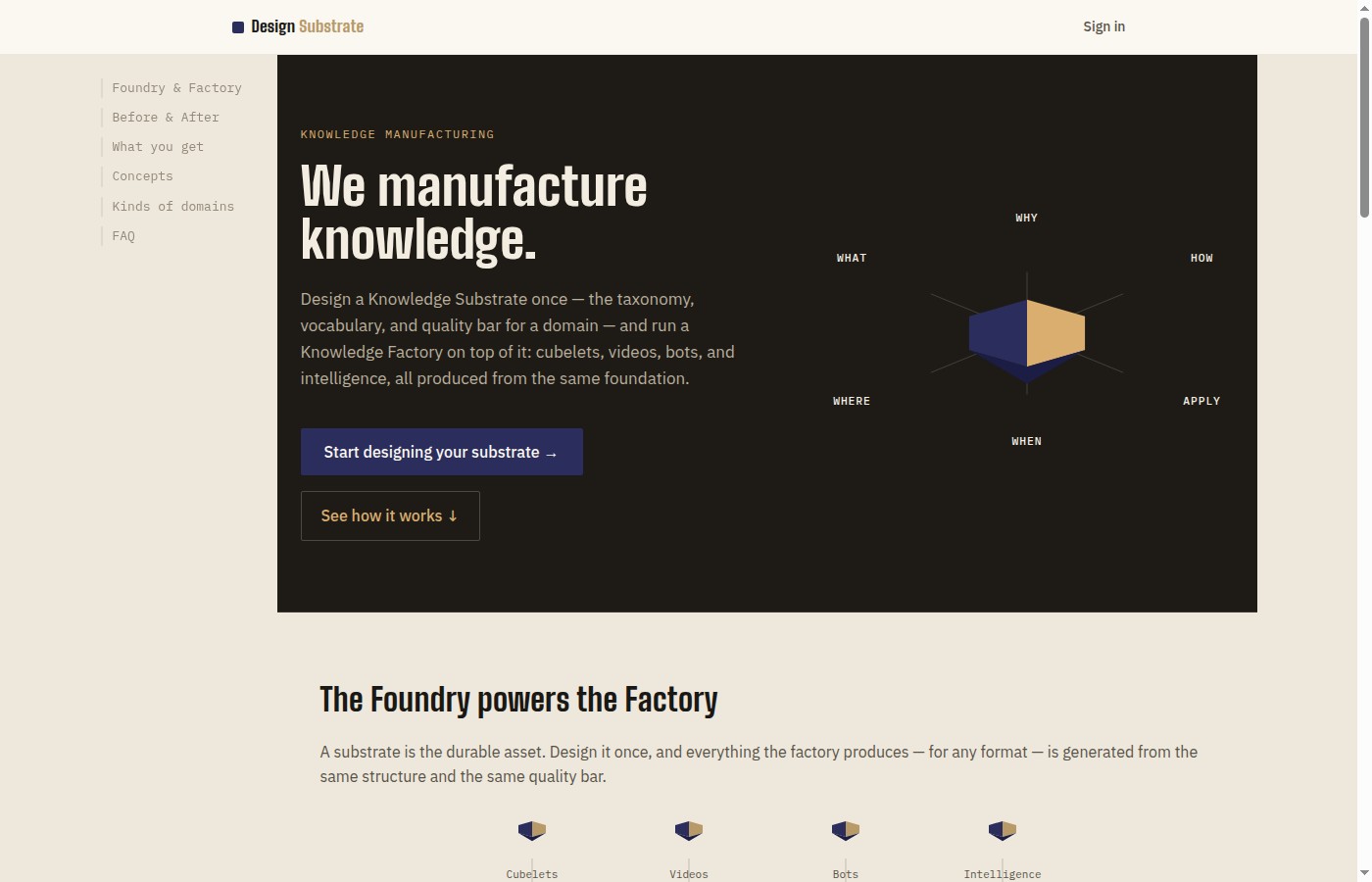
design.cubelet.ai — live tool · free to explore
// what is a substrate
One foundation.
Every output.
A Knowledge Substrate is the versioned architecture your content runs on. It captures what your organization knows — across frameworks, subject matter, and roles — as a controlled, navigable structure.
From one substrate, the GRID42 Knowledge Factory produces Cubelets, narrated videos, AI simulation scenarios, assessment questions, chatbots, and intelligence feeds. When the substrate updates, all outputs update with it.
Design is where you define that substrate. It's the diagnostic step before production — and for complex domains, it's also the starting point for a full Substrate Readiness Assessment.
Cubelets
Six-dimensional knowledge atoms — one per concept, across WHAT / WHY / HOW / WHERE / WHEN / APPLY
Narrated Videos
Short-form video produced from each cubelet face — consistent voice, governed pacing, automatic captioning
Simulation Bots
AI-guided scenario simulations grounded in substrate knowledge — for applied judgment practice
Intelligence
Regulatory signals mapped to substrate nodes — so you know which cubelets are affected when frameworks change
// design process
From raw knowledge to governed substrate.
The design tool walks you through four stages. Explore freely, or bring your GRID42 knowledge architect for the guided version.
Map your domains
Identify the knowledge domains your organization needs to capture — regulatory frameworks, operational procedures, technical specializations. Design ingests your source documents and maps the conceptual terrain.
Define the vocabulary
Every substrate has a controlled vocabulary — the authoritative terms, their synonyms, and their hierarchy. Design builds this automatically from your source material, then lets you refine it.
Match an archetype
GRID42 classifies knowledge systems into archetypes — regulatory compliance, operational qualification, technical certification, and more. Your archetype determines the cubelet structure, face weights, and assessment style.
Production-ready brief
Design outputs a complete substrate brief: taxonomy, vocabulary, archetype, quality bar, and production scope. This is the handoff to the Knowledge Factory — or the starting document for your Substrate Readiness Assessment.
Self-service
Explore for free
Use design.cubelet.ai to map your domains, generate a vocabulary, and see your substrate architecture — at no cost. Outputs include a substrate brief you can bring to an Outcome Workshop.
Free
No account required to explore
Facilitated
Brief intake session
Work with a GRID42 knowledge architect to run the design tool against your real domain — your frameworks, your source documents, your SME knowledge. Outputs a production-ready substrate brief.
- ✓ Guided domain and framework mapping
- ✓ Vocabulary review and curation
- ✓ Archetype recommendation with rationale
- ✓ Substrate brief document for production handoff
- ✓ Production economics estimate
Starting at
Contact for pricing
Separate from the SRA · Scoped to your domain
Ready for the full picture?
A Brief Intake session produces a substrate brief. For organizations that need a comprehensive gap analysis, production scope, and full engagement roadmap, the next step is a Substrate Readiness Assessment ($28,000–$150,000). Most organizations begin with the free tool, then scope the SRA from the brief.
Your substrate is the asset.
Every Cubelet, video, simulation, and intelligence feed your organization produces runs on the substrate. The time you invest in design compounds into every output that follows.